

It’s easy to make a telematics switch look great — on paper
No fleet switches telematics providers on a whim. Frustrations can build for months, sometimes years, with support teams who don’t understand the daily reality of trucking, platforms that don’t integrate well with the tools the fleet is using: the TMS, the fuel card system, the vehicle maintenance software. Other common post-sale frustrations include a price tag that feels too high for what the fleet is getting, or the reverse — a cheap, but unreliable platform that keeps drivers on the phone with dispatch instead of moving down the road.
Who is at fault for those telematics switch frustrations? Rarely any one party. The reality is that by the time a fleet signs with a new provider, everything is likely looking great on paper. The sales process went well. The new features promise to solve every pain point the fleet has. Go-live is scheduled.
The regret, when it shows up, usually arrives later — in the weeks and months when the new technology meets everyday operations, and gaps start to appear.
This article covers where those gaps come from, and what you can do to avoid them.
Quick answer to why fleets regret switching telematics providers
Fleets primarily regret their switch in the following three scenarios:
- A fleet picks a provider that performs well in the sales demo, but underdelivers after go-live.
- Both the provider and the fleet rush the transition without bringing in key team members early in the process.
- The fleet forgets to assign the people and time it takes to integrate and use the new technology in their everyday operations and workflow.
Read on to learn how a fleet can avoid these pitfalls early on, to ensure smooth operations for years after go-live.
Scenarios to avoid when switching telematics providers — and what to do instead
Scenario 1: What looked great in the demo doesn’t work in real life
Sales demos are built to succeed. The prospective provider will make sure that during the demo, a test delivery goes through the system cleanly, the proof of delivery lands where it should, dispatch sees the status update, and billing gets triggered. Everything looks great, and fleets can’t wait for this technology to save them time and money.
Real operations, unfortunately, are messier than controlled demos. What if your driver finishes a delivery in a yard with poor cellular reception? Say the POD upload doesn’t complete because the provider’s platform relies on a cellular connection to work. The next morning, nobody in the office knows whether the load closed out — the TMS is still showing it as in transit, the billing team can’t invoice, and dispatch is trying to reach the driver working on a different delivery. Multiply that by a hundred deliveries a week, and the back office ends up re-entering half the week’s loads by hand.
The blind spot: The cellular-dead-zone problem isn’t a fluke — it’s the downstream consequence of what the provider failed to address. A provider who shows up to a first meeting with only a polished demo and no questions for you is a provider who isn’t studying how your fleet actually runs. Their demo reflects what their system can do in ideal conditions, but does it fit with your fleet’s reality?
Bottom line: The real gap here is between providers who do their homework before the switch, and providers who don’t.
What to look for: Ideally, seek out a provider whose deployment team has spent time in the trucking industry, not just building software in general. Ask who’s going to lead the deployment, how long they’ve worked in the industry, and how they get familiar with the fleet’s operations before deploying their solution or writing a single line of code for promised features. In special cases, the best providers will want to spend time on-site before deployment starts, walking through a dispatcher’s screen, a driver’s daily sequence, a billing clerk’s handoffs, to really get to know the fleet and their needs.
Scenario 2: Key people in the fleet don’t get a say in the technology switching conversation
In many cases, the switching conversation gets driven by operations, IT, or leadership teams. Safety teams might find out when the decision has been made. Then compliance finds out when the training calendar lands. Drivers find out close to go-live, often through a short memo or a dispatcher mention, with little room to ask questions before the device is in the cab. Where’s the problem with that?
The blind spot: For one, safety and compliance teams hold institutional knowledge the buying committee doesn’t. They know which old-platform reports actually held up during a compliance audit, which system integrations the fleet currently depends on, and which provider-side system updates have blown up workflows before. Leave that knowledge out of the evaluation, and it resurfaces during rollout — usually as a scramble to rebuild something that was working beforehand.
Drivers matter for a different reason. They care about one thing: will this help them drive more miles, or will it slow them down? To a driver, a minute is a mile, and a tool that adds two minutes to every stop is a tool drivers will resist, sometimes silently, by finding workarounds.
Getting every stakeholder in a room before the decision is ideal. Unfortunately, most fleet managers don’t have that kind of time, while the pain driving the switch feels urgent. However, we’ve seen clients find ways to involve the people who will live with the platform from the beginning, not as an afterthought.
Decker Truck Line’s technology forum is one good example of early involvement. Before finalizing their move to a new platform, Decker’s leadership team met in Fort Dodge with five of their drivers to preview the new ISAAC tablets, ask questions in real time, and share what was working and what wasn’t in their current system. After the demo, CEO Dale Decker and COO Bob Decker stayed for over an hour talking with drivers. It was Decker’s fourth forum of the kind.
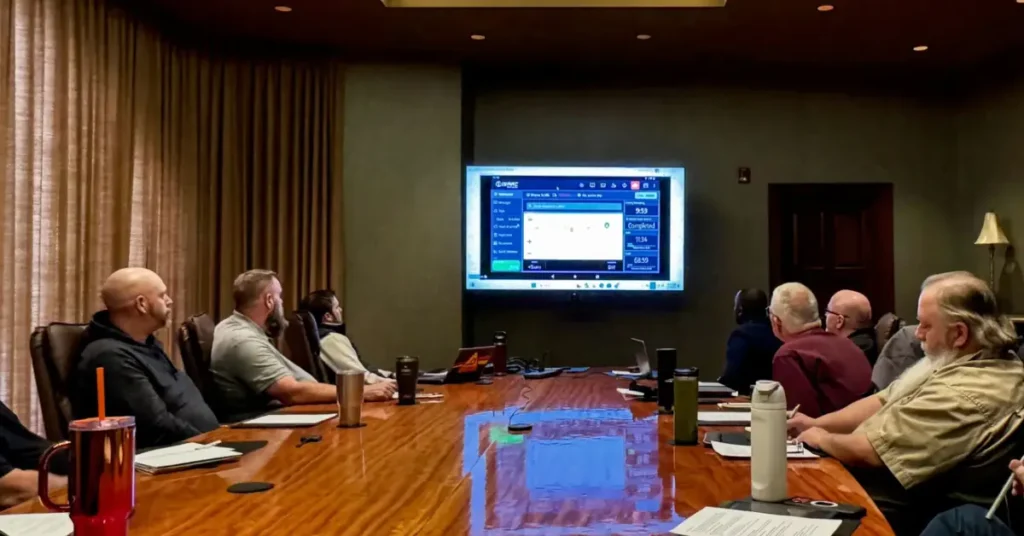
Some fleets run driver advisory panels. Others invite safety and compliance leads into the vendor selection process from the beginning. The intent is more important than the shape — giving the people who will use the platform a say before the contract gets signed goes a long way.
What to look for: A provider willing to meet the fleet’s stakeholders where they are, including the drivers, helps ensure success. A sales process that treats drivers as end users worth listening to, not as a training detail to look at later, is a signal of how the provider will behave after go-live.
Scenario 3: The platform is in place, but the process isn’t
It’s important to realize that a telematics platform is a tool, not the entire solution. A tool can be excellent, but a fleet still has to decide how they will use it in their operations, who the main users are and the role they play in using it.
For example, understand that driver-coaching tools don’t lower fuel costs on their own. In addition to drivers using the feature inside the cab, someone has to review the driving performance scores, sit with the drivers, and run an incentive program that motivates driving behavior changes.
Deploying AI cameras is also a good example of why you have to plan for people and processes — not just tech — when implementing a new system. Although a good AI camera system may filter alerts to surface only events that truly matter, someone must still review them and talk with the drivers involved. If the safety team is already stretched, alerts simply pile up. Unreviewed events don’t help in a claim — and can even become evidence that the fleet had visibility on a problem and did nothing.
The blind spot: The business case presented to leadership for the new platform likely focused on technology. The benefits the fleet is expecting — safer drivers, lower fuel spend, faster coaching cycles — depend on people, processes, and technology working together. Leave any of the three out and the ROI stays only in one place: the provider’s slide presentation.
What to watch out for: Before signing for a technology switch, map out the concrete benefits the fleet expects from the platform and who on the team will be responsible for each outcome. The technology can surface risky driving, but a driver coach needs to act on it. The platform can simplify dispatch, but dispatchers need to adopt the new workflow. Match every promised result to a named owner on the fleet’s side. If the plan is that the platform will handle it, there is no plan.
What a well-prepared telematics switch looks like
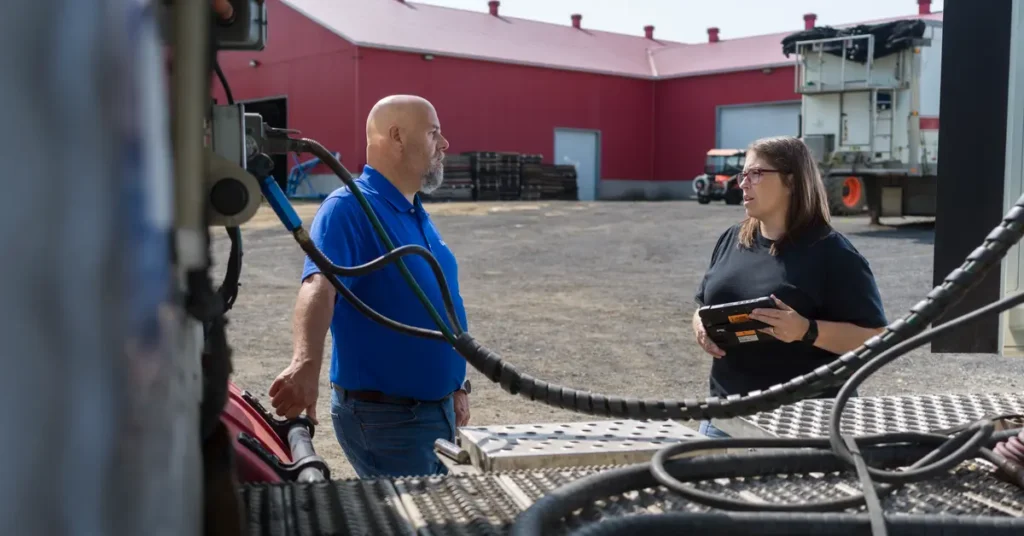
A smooth telematics switch shares a few patterns. Consider using the following as a checklist of must-haves before signing. It can require some effort upfront, but yield years of benefits.
- Integration is planned in phases, with a partner who understands trucking. A good provider knows to map out existing workflows, making sure the new setup covers what the fleet already depends on in their existing system, and then, and only then, adds the new capability that drove the switch (AI cameras, advanced in-cab coaching, etc.). In an industry where a minute is a mile, minimum disruption in the short and long term is a top priority.
- A named project manager runs the transition end to end. Good telematics providers assign a single point of contact for the fleet, to ensure smooth, coherent collaboration from contract signing through to go-live and beyond.
- Safety, compliance, and dispatch are involved in the evaluation phase. You don’t need every team member in every meeting, but you should hold at least one working session with the people who will use the platform every day. The goal is to capture practical feedback early and make sure the team feels included before the contract is signed.
- The in-cab device for drivers can handle the job. Make sure the hardware can run reliably at -20°F in a Minnesota yard and 110°F in an Arizona truck stop, handle the vibrations common in trucking, and survive being dropped, because it very likely will be. Consumer-grade tablets have a high failure rate — and a driver whose tablet dies mid-shift is a frustrated driver who may rack up costly out-of-route miles to get the device replaced.
- The data handoff is planned before the old system is shut down. That includes a documented plan for hours-of-service records that show maintained compliance over the system transition, with US drivers needing the current day plus the previous seven days at roadside inspection and Canadian and cross-border drivers needing the current day plus the previous fourteen. Miss this, and drivers can be found non-compliant at a roadside check through no fault of their own. The data handoff should also include historical safety trends, fuel baselines, and any audit documentation, so the fleet doesn’t lose data when the old system is shut down.
- Instead of running pilots to evaluate providers, talk to their clients. A two-month pilot with two trucks can be made to look great on paper, just like a sales demo. For more useful information, ask the provider for fleets that have been running the platform at scale for two or more years, and ask the provider to put you in touch with them. Actual users have years of experience to draw on over their whole fleet — much more than you can experience in a short pilot with a few trucks. Ask them how responsive the provider was to change. Were there issues, and how were they overcome? What was the implementation and the ongoing support like? Would they pick this provider again?
- Understand the trade-offs — every system change has them. For instance, if a fleet leaves a cheaper telematics provider, it’s probably trading a lower price for better support quality. If leaving a provider serving various industries and continents, a carrier is probably trading some generalist features for trucking-specific expertise and functionality. Decide what matters most before signing, not after.
What can you expect from following this checklist? A couple of months of real work upfront, then years of benefit. With enough preparation from the fleet and the technology provider, drivers are usually operational within hours of their training, and the fleet stabilizes within a few weeks to a few months, depending on integration depth.
Key takeaway
Fleets put a lot of time into choosing the right telematics provider. Once this is done, one of the biggest factors that puts your success at risk is rushing the switch — especially with a provider that doesn’t have the proper project team in place to help manage the process.
Fleets that treat the system transition with the same rigor they used to choose the provider tend to compound value year over year. They don’t spend the next three to five years locked into a decision they wish they’d pressure-tested. Unfortunately, fleets living with rushed transition consequences often don’t get their expected ROI.
Interested in reading about fleets that did it right? Read our client success stories.
Common questions about switching fleet telematics providers
Why do fleets regret switching telematics providers?
Most of the regret linked to a telematics system change comes from problems that surface after go-live — integrations that don’t fit the fleet’s actual tools, provider support teams that don’t understand trucking, pushback from internal teams that weren’t part of the decision. Technology itself is rarely the issue. Fleets that focus only on price and features during the evaluation tend to underestimate the operational implications of the transition itself.
What do fleets underestimate when changing telematics systems?
The most common blind spots of carriers when changing telematics providers are integration depth with the fleet’s current tools and workflows, hidden costs from bring-your-own-device or multi-vendor models, and the internal resources needed to actually use the platform once it’s installed. Data handoff is another — drivers need continuous access to their recent hours-of-service records, and a rough migration can leave them non-compliant at roadside inspection.
How can fleets minimize disruption during a telematics transition?
You can minimize disruption during a telematics transition by giving the people who’ll use the platform every day — drivers, safety, compliance, dispatch — a voice before the decision gets made. Verify the integration supports the fleet’s current workflows and tools, making sure to go beyond sales demo scenarios. Skip short pilots and call fleets that have been running the provider’s platform for two years or more. And plan the data handoff early, especially hours of service and historical safety records.